← Back to Blog

How Jacksonville Auto Dealerships Are Rethinking Advertising in 2026
By WilDi Maps·
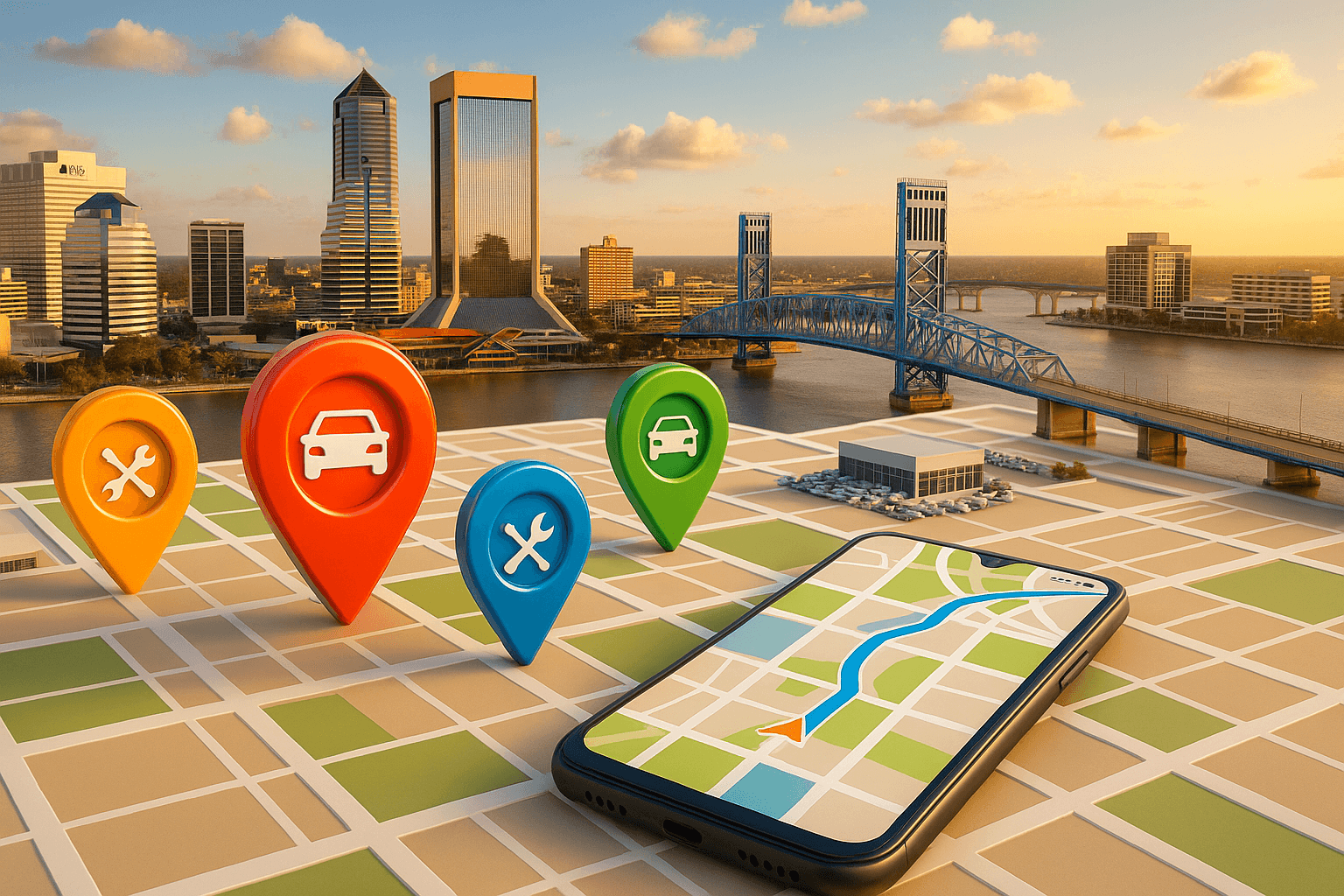
Modern Jacksonville auto dealership showrooms on 3D city map with digital location pins, representing the future of automotive advertising in 2026

The Atlantic Boulevard Paradox

Drive down Atlantic Boulevard on any Saturday afternoon and you'll pass at least a dozen dealerships within a three-mile stretch. Giant inflatable gorillas wave at traffic. Balloons cluster around "SALE" signs the size of billboards. Finance banners promise zero percent interest. It's a gauntlet of automotive retail, and every single one of these dealers is hemorrhaging money trying to catch your attention.

The irony? Most of them have no idea whether it's working.

According to NADA's 2024 Annual Data, the average dealership in the United States spends more than $600,000 per year on advertising. In a market as competitive as Jacksonville, where the Florida Department of Highway Safety and Motor Vehicles reports over 100 licensed dealerships operating in Duval County alone, that number climbs higher. Some of the larger operations on Southside Boulevard and the Philips Highway corridor are spending well into seven figures annually.

That's a lot of TV spots during Jaguars games. A lot of drive-time radio. A lot of billboards along I-95 and I-295. And for what? A customer walks onto your lot, buys a truck, and you have absolutely no way of knowing whether they saw your ad or just happened to drive by on their way to Lowe's.

The Spending Reality in Jacksonville's Auto Market

Jacksonville's dealership ecosystem is one of the most saturated in Florida. You've got the big players, Nimnicht, Hanania, Coggin, spread across multiple locations. Then there's the independents, the used car specialists, the luxury brands clustered near Town Center, and the volume dealers battling it out on Blanding Boulevard.

When you factor in market-specific costs, a mid-sized Jacksonville dealership is realistically spending somewhere between $40,000 and $80,000 per month on advertising. The larger groups? Double or triple that. Traditional media still eats up the lion's share. A thirty-second TV spot during local news runs $1,500 to $3,000 depending on the time slot. Radio is cheaper but requires frequency to work, you're looking at $800 to $2,000 per week for a decent schedule on a single station. Billboards on major arteries like J. Turner Butler Boulevard cost $3,000 to $8,000 per month per board.

All of this assumes people are paying attention. They're not.

Cox Automotive's 2024 Car Buyer Journey study found that 79 percent of car buyers begin their research online. They're comparing prices on Autotrader, reading reviews on Edmunds, checking inventory on manufacturer websites. By the time they visit a dealership, they've often already decided on the make and model. Yet here's the kicker: 95 percent of those digitally savvy buyers still complete their purchase in person at a physical dealership.

So buyers are online, but they're buying offline. Traditional advertising can't bridge that gap. Digital advertising should be able to, but most dealerships are finding out the hard way that Google Ads and Facebook campaigns come with their own expensive problems.

The Digital Advertising Money Pit

Automotive keywords are some of the most expensive in the digital advertising world. Search for "Toyota Camry Jacksonville" and you're competing against every dealer in the region, plus national aggregators, plus lead generation companies that will sell your click to the highest bidder. Cost-per-click for auto-related terms routinely hits $5 to $15. Some high-intent keywords, think "Lexus lease deals near me", can spike above $20.

That adds up fast. A dealership spending $10,000 per month on Google Ads might generate 800 to 1,500 clicks. Sounds promising until you realize half of those clicks are coming from people with no intention of buying. Tire kickers. Researchers gathering data for a purchase six months down the road. Folks who live in St. Augustine or Fernandina Beach and aren't going to drive to your lot anyway.

Facebook and Instagram ads fare a little better on cost, but targeting is scattershot. You can aim at people interested in "automobiles" or "car shopping," but you're still casting a wide net. A Riverside resident who just bought a car last month is seeing your ad. So is someone in Orange Park who exclusively buys used cars on Craigslist. So is a teenager who clicked on a car meme once and got flagged as "automotive-interested" by the algorithm.

None of this tells you who's actually in the market right now, today, ready to buy.

Geo-Fencing: Targeting People Where They Already Are

Here's a different approach. Instead of broadcasting your message to everyone and hoping the right person sees it, what if you could advertise directly to someone standing on a competitor's lot?

That's geo-fencing. You draw a virtual perimeter around a physical location, say, the Hanania Automotive Group on Atlantic Boulevard, and serve ads to anyone whose phone enters that zone. When they leave and start browsing the web or scrolling through apps, your dealership's ad appears. Not a generic "check out our inventory" message, but something specific: "Couldn't find the Silverado you wanted? We have 12 in stock."

The applications for Jacksonville dealerships are immediate and obvious. You can fence every competitor on the Atlantic Boulevard auto mile. You can target service centers, people getting their ten-year-old car repaired are statistically more likely to be considering a replacement. You can geofence the parking lots at Town Center or St. Johns Town Center, catching people in a shopping mindset. You can even target the Avenues Mall or Orange Park Mall on weekends when families are out and might swing by a dealership afterward.

The data changes everything. You're not guessing whether your ad worked. You know how many people saw it, how many clicked, and, most importantly, how many showed up at your dealership afterward. Mobile ad platforms can track when a device that was served an ad later appears at your physical location. That's attribution traditional media will never have.

The Conquest Campaign: Hanania vs. Nimnicht

Let's get specific. Imagine you're running marketing for Nimnicht Chevrolet on Philips Highway. Your biggest local competitor is Hanania, which has a massive presence on Atlantic Boulevard and Beach Boulevard. Hanania spends heavily on TV and radio. They're visible. They're established. They're getting foot traffic.

A traditional response would be to increase your own TV and radio spend, trying to out-shout them. Expensive and inefficient.

A geo-fencing conquest campaign flips the script. You fence Hanania's lots. Every person who visits Hanania looking at a Chevy Tahoe gets served your ad within an hour: "Compare Before You Buy, Nimnicht Has the Best Price on Tahoes in Jacksonville." You're not fighting for general awareness. You're intercepting buyers at the moment of highest intent.

Now imagine Hanania retaliates with their own geo-fence around your dealership. Suddenly you've got a hyper-targeted advertising war happening in the background, invisible to traditional media buyers, but brutally efficient. The dealership with the better offer, the better creative, and the smarter targeting wins. Not the one with the biggest billboard budget.

This isn't theoretical. Dealerships in competitive markets across the country are already doing this. Jacksonville, with its clustered dealership corridors and mobile-heavy population, is perfect for it.

Cost Comparison: Old vs. New

Here's what $10,000 in advertising budget looks like across different channels for a Jacksonville dealership:

ChannelWhat You GetEstimated ReachAttribution
Local TV (30-sec spots)3-5 spots during local news or Jaguars pregame15,000-40,000 impressionsNone, no way to track who visited
Radio (drive-time schedule)4-6 weeks on a single FM station25,000-50,000 impressionsNone, maybe a "mention this ad" promo code
Google Ads (search)800-1,500 clicks on high-intent keywordsHighly targeted but expensive per clickClick tracking, some conversion tracking
Geo-Fencing (mobile)50,000-100,000 ad impressions to people at competitor lots, service centers, high-traffic retailPrecision-targeted to in-market buyersFull attribution, track who saw ad and visited your lot

The cost-per-acquisition difference is staggering. A dealership running geo-fencing campaigns can often achieve 60 to 80 percent lower cost-per-visit compared to traditional broadcast, and the quality of the visit is higher because the person has already demonstrated buying intent by visiting a competitor or service center.

What the Smart Dealers Are Doing Differently

The most forward-thinking dealerships in Jacksonville aren't abandoning traditional advertising entirely, brand awareness still matters, but they're reallocating budget in ways that would have been unthinkable five years ago.

Instead of spending $50,000 a month on TV and hoping for the best, they're splitting it: $25,000 on TV for broad brand presence, $15,000 on geo-fencing conquest campaigns targeting competitor lots and service centers, and $10,000 on retargeting people who visited their website but didn't convert. The result is a layered approach where every dollar is working harder.

They're also getting hyper-local in ways broadcast can't match. A Southside dealership might run a specific campaign targeting only people who live within a five-mile radius and have been to a service center in the past thirty days. A luxury dealer near Town Center might fence the valet parking at Ruth's Chris and Ocean Prime, knowing that's their demographic. A volume dealer on Blanding Boulevard might fence the Navy base, targeting enlisted personnel with first-time buyer programs.

The common thread? Precision. Stop advertising to everyone. Start advertising to the people who are actually ready to buy.

The Local Advantage

Jacksonville dealerships have one often-overlooked advantage: local expertise. National advertising platforms and big agency-driven campaigns don't understand that someone shopping on the Southside probably isn't driving to a dealership on the Westside, or that Ponte Vedra buyers have different expectations than Arlington buyers. A Jacksonville-based platform built specifically for geo-targeted advertising can outperform generic national tools because it understands the market's quirks.

For dealerships tired of burning money on ads they can't measure, there are better options. WilDi Maps, a veteran-owned, Jacksonville-based advertising platform, specializes in exactly this kind of precision geo-fencing for local businesses. It's built for the Atlantic Boulevard auto mile, the Southside corridor, and every dealership in between that's ready to stop guessing and start knowing where their customers come from.

The dealerships that figure this out first, the ones that stop thinking about advertising as a megaphone and start thinking about it as a scalpel, are going to dominate. The ones still buying the same TV and radio packages they've been running since 2015 are going to wonder why their cost-per-sale keeps climbing while their competitor down the street is selling more cars with half the ad budget.

It's 2026. The inflatable gorillas aren't going anywhere. But the smartest dealers in Jacksonville have already moved on to something better.

Tags: Auto Dealership Marketing, Jacksonville Advertising, Location-Based Advertising, dealer advertising, Local Business, Small Business Advertising